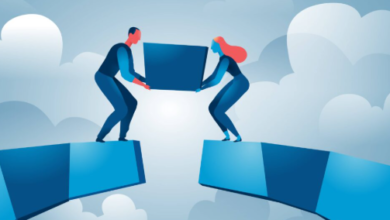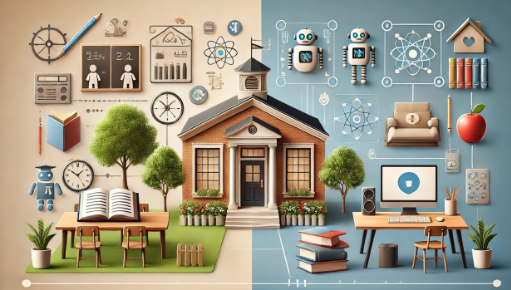
The traditional form of school with its set schedule, large class sizes, and standardized progression was created in the industrial revolution to produce obedient and efficient workers. It was not made for neurodiverse students, for those who require more advanced learning, or for those who learn differently in general. Parents are not rejecting the concept of education but rather a broken system that has remained the same for centuries.
The movement towards homeschooling and online education is not a small uprising; it is a response to a failing system that is unable to cater to the needs of all students.
The Factory Model and Who it Leaves Behind
Traditional classrooms assume that children of the same age learn at the same pace, in the same manner, and with the same incentives. Teachers, parents, and students themselves know that this is far from reality.
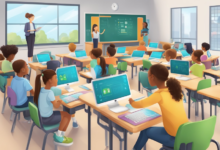

Differentiated instruction theoretically can happen in a room of 30, but it’s tough. The kid who understood the concept in 10 minutes is twiddling their thumbs while the rest of the class gets it. The kid who needed 40 minutes is left behind. In neither case is the teacher to blame. It’s the structure.
Self-paced progression fixes this. When a student can advance based on mastery rather than the time ticking by, they’re not waiting, nor are they hopelessly behind. They’re learning.
Mental Health Isn’t a Secondary Concern
Peer pressure, bullying, and the pressure to perform are common reasons why many students experience stress in traditional high schools. In fact, for these students, it is often the actual school environment that is anxiety-inducing, rather than external circumstances of their life.
Releasing that daily stressor frequently results in an immediate change in academic engagement. Parents who remove their kids from these models often find that the child’s attitude to learning transforms rather fast. When they take away the social aspect of the hallway, the cafeteria, and the peer group, studying is suddenly something a student can simply engage in.
Flexible models also give social-emotional learning more space, not less. When a student isn’t locked in a schedule almost every waking hour, they have the opportunity to develop their self-awareness, emotional and interpersonal competencies, all that research is showing more than ever to be a predictor of success decades after graduation.
Geography is no Longer a Barrier to Quality
One of the most profound shifts in the past ten years is that the physical location of a student is no longer a reference point for the quality of the curriculum available to them.
For instance, a learner in an outlying area or a region that lacks adequate high-school choices can now access the Cambridge International curriculum exactly as a student in a major commercial center. Any student who desires a world-wide recognized course can attend an Online High School South Africa with no need to move or settle for less.
This is important for two interrelated reasons. First of all, it makes the competition fairer for those families who live outside the peripheries of big cities. Furthermore, it decouples where you live from access to a good quality of education, something the normal high school system has never been able to achieve.
See also: Smart Home Design Essentials: Integrating Technology Without Disrupting Aesthetics
Skills the Modern Economy Actually Rewards
The careers that are not just being created now, but will exist in ten years – demand autonomy over your own time, the ability to work asynchronously across continents and time zones, the capacity to locate, vet, and apply information without reliance on external direction, and a high degree of fluency with digital tools. These aren’t “soft” competencies. They’re prerequisites.
And a student who spends four years designing, managing, and optimizing their own online learning schedule, engaging with asynchronous content, and assuming the lion’s share of the responsibility for their progress and outcomes, is literally in the process of acquiring them. Not as an elective extension. As the architecture of their education.
Homeschooled students typically score 15 to 30 percentile points above public-school students on standardized academic achievement tests, regardless of their parents’ level of formal education. The mechanism behind that gap isn’t a mystery, it’s what occurs when you remove a student’s position as an input of the educational industrial complex and install them as a driver of their own education instead.
The Socialization Argument Doesn’t Hold Up
The most common argument against homeschooling is the issue of socialization. Yet, it is also the most irrelevant one.
It is not a matter of if alternative learners socialize, they do. It is a matter of what type of socialization leads to better results. Being grouped with 200 people born in the same calendar year, in the same postcode, is not a model of the real world. It’s an artificial environment that happens to be familiar.
Students in online and home-based programs tend to participate in more intentional, age-diverse, interest-driven communities via sport, arts programs, co-ops, online collaborative projects, and community activities. The social experience is different. For most, it’s broader.
Where This is Heading
Parents who are increasingly moving their children into alternative education models aren’t making this choice in pursuit of some utopian ideal or out of disdain for the traditional system. They’re opting into a version of education where the student has more agency, the curriculum has more flexibility, and the daily experience isn’t structured around a 19th-century factory floor.
Conventional classrooms won’t disappear. But they’ll increasingly share space with models that treat the student as an active participant in their own education, not a passive recipient of it.