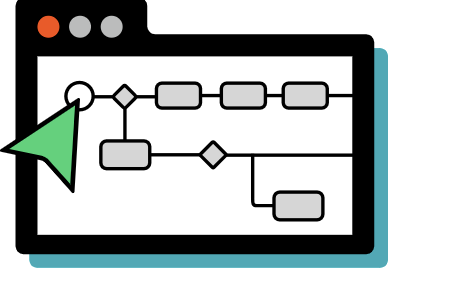
Process optimisation starts with a clear picture of work, not opinions. BPMN 2.0 (Business Process Model and Notation) is an industry-standard way to document how a process runs today (As-Is) and how it should run after improvements (To-Be). Because BPMN uses precise symbols for events, tasks, decisions, and hand-offs, it reduces ambiguity and makes bottlenecks easier to spot. This article explains a practical approach to mapping As-Is and To-Be workflows using BPMN 2.0.
Why BPMN 2.0 works better than ad-hoc flowcharts
BPMN 2.0 gives teams a common language that is readable for stakeholders and detailed enough for analysts and implementers. A good BPMN model answers three questions quickly: who performs the work, what happens next, and where information moves.
Key BPMN building blocks
Events mark something that happens, such as “request received”. Activities represent work, including tasks and sub-processes. Gateways show branching and merging, such as approval decisions or parallel work. Sequence flows show the order of steps within one participant, while message flows show communication between participants. Pools and lanes show ownership, which is often where delays are created.


What BPMN makes explicit
Unlike a basic flowchart, BPMN distinguishes internal flow from cross-team communication and supports modelling waits and exceptions in a controlled way. That precision matters when you are reducing cycle time, lowering errors, or preparing a process for automation.
How to build an accurate As-Is BPMN map
An As-Is map is a factual model of what happens now, including exceptions and workarounds. If the As-Is model is wrong, the To-Be design will solve the wrong problem.
1) Define scope and boundaries
Start with a single trigger and a single outcome. For example, “customer submits onboarding documents” to “account is activated”. Identify what is outside the scope, such as upstream marketing. Tight boundaries keep diagrams readable and actionable.
2) Identify participants and hand-offs
Create pools for distinct parties, such as Customer, Sales, Operations, and Finance. Use lanes for roles within a pool. This structure makes ownership and hand-off points visible, which helps you locate queue build-up and duplicated checks.
3) Model the main path, then the real variants
Draw the happy path first. Then add common exceptions, such as missing information or rejected approvals. Use gateways for decisions and show rework loops when they occur. If detail becomes heavy, move parts into collapsed sub-processes so the main diagram stays clear.
4) Validate with walkthroughs and evidence
Review the diagram with the people who do the work. Then confirm with timestamps, queue durations, and rework rates. This step turns BPMN into a shared baseline rather than “a diagram on a slide”.
If you are learning this method through a business analysis course in pune, strong As-Is validation is one of the fastest ways to build trust with operations teams and leadership.
See also: Common Tax Problems for Businesses and How Experts Fix Them
Designing a To-Be BPMN model that drives measurable gains
A To-Be map should represent deliberate change with measurable outcomes. Every new step, control, or automation must have a clear purpose.
Remove waste before adding tools
Eliminate non-value steps, duplicated data entry, and approvals that exist only because of legacy policy. Simplification reduces effort and makes automation safer.
Use BPMN patterns to improve flow
Run independent tasks in parallel with parallel gateways, such as verification and document checks. Use event-based gateways when the next step depends on which event occurs first, such as customer response versus timeout. Use boundary events to manage exceptions, such as escalation on a missed deadline, without cluttering the main path.
Clarify rules, ownership, and measures
When a gateway represents a rule, document the criteria and required data. Assign ownership for controls and hand-offs. Decide where you will capture key metrics like cycle time, queue time, first-pass yield, and defect rate, so monitoring is routine.
From BPMN to implementation and governance
BPMN delivers value when it connects to execution. Translate the To-Be model into SOP steps, RACI ownership, system requirements, and training content. Pilot the change with a limited scope, measure outcomes against the As-Is baseline, and refine. Keep diagrams versioned with change logs and a clear approval path so the process stays current.
Teams that adopt this habit, often reinforced through a business analysis course in pune, find it easier to align stakeholders, reduce rework, and sustain improvement.
Conclusion
BPMN 2.0 process mapping helps organisations move from unclear discussions to disciplined optimisation. By documenting an evidence-based As-Is model, designing a To-Be model with explicit rules and measures, and linking the diagram to implementation and governance, you create workflows that run more smoothly today and are easier to improve tomorrow.